30 Mar, 2026
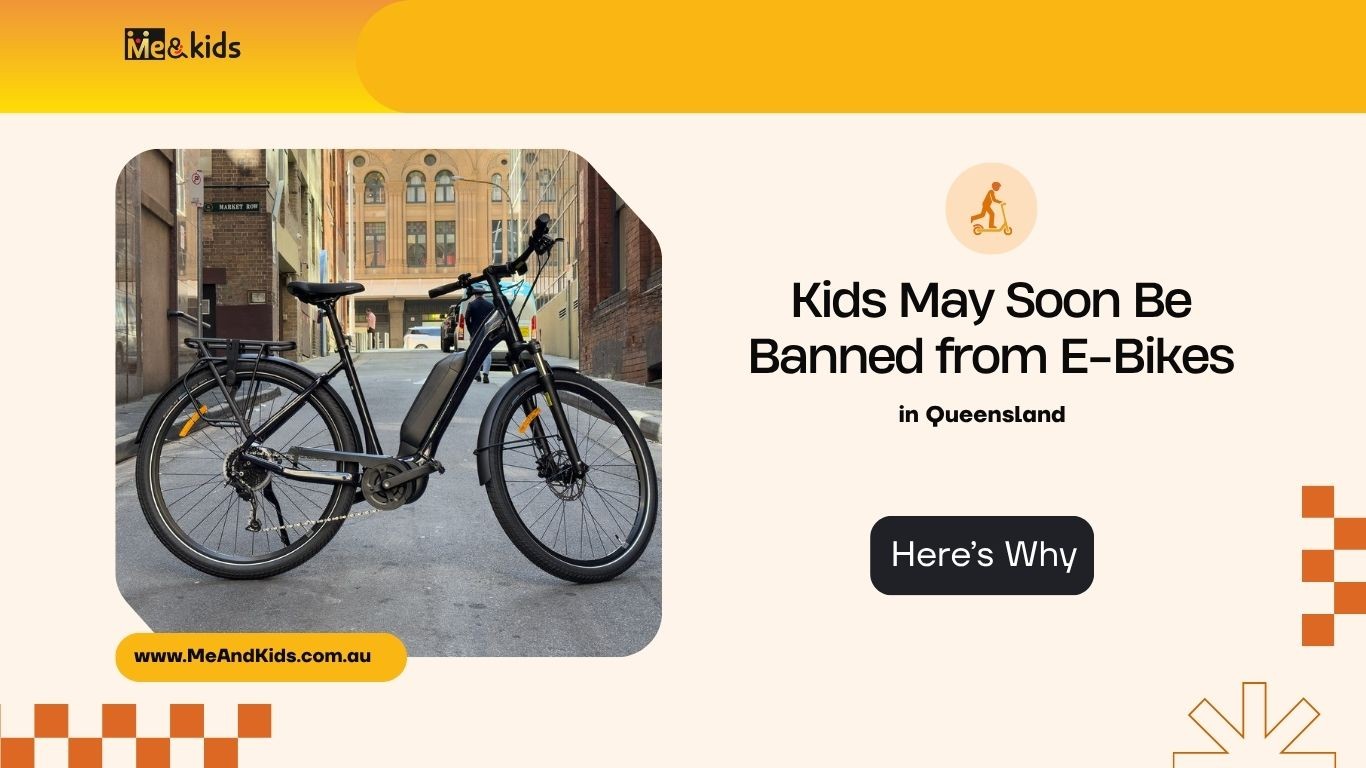
E-bike ban Queensland - In March 2026, Queensland introduced what its own Transport Minister described as nation-leading reforms on electric mobility devices, banning children under 16 from riding e-bikes and e-scooters on public roads and paths, requiring all riders to hold at least a learner driver's licence, and granting police new powers to seize and destroy illegal devices on the spot. The reforms follow a devastating year in which 12 people were killed and more than 6,300 were injured in e-mobility incidents across Queensland alone. On the same day, New South Wales introduced legislation giving police and transport officers the power to seize and crush illegal e-bikes using roadside testing equipment. This guide covers everything Australian families need to know about the new laws, what they mean in practice, what the penalties are, and how the national e-bike regulatory landscape is shifting state by state.
For years, e-bikes and e-scooters occupied a grey area in Australian law. They were legal to buy, often aggressively marketed to children and teenagers, and widely used on footpaths, shared paths, and roads with minimal regulatory oversight. The result was predictable: hospitals across the country filled with injured riders, emergency departments logged thousands of presentations related to e-mobility incidents, and questions about who bore responsibility, the rider, the parent, the retailer, or the government, went largely unanswered.
Queensland has now drawn a clear line. In late March 2026, the state government accepted all 28 recommendations made by a landmark parliamentary committee inquiry into e-mobility safety, and introduced sweeping reforms that represent the most comprehensive response to e-bike and e-scooter misuse any Australian state has produced.
The headline measure is a ban on children under the age of 16 from riding e-bikes and e-scooters on public roads and paths. But the reforms go considerably further than that. They restructure the entire framework within which electric mobility devices are used in Queensland, linking every element of usage to licence status, medical fitness, age, speed limits, and police powers that were simply absent before.
For Australian families who own, or are considering buying, an e-bike or e-scooter for their children, these changes are not optional reading. They are the new legal reality, and the penalties for non-compliance fall not just on the rider but on the parent.
The Queensland reforms, introduced to parliament in the final week of March 2026, establish the following requirements and prohibitions.
Children under 16 are banned from riding e-bikes and e-scooters on any public road, shared path, or footpath. The exemption covers electric wheelchairs and other powered accessibility devices for people with a disability. Transport Minister Brent Mickelberg was direct about the rationale: the child safety transport Australia of children was the paramount consideration, and the evidence from a year of fatalities and thousands of emergency presentations had made legislative action unavoidable.
All riders aged 16 and over must hold at least a Queensland C-class learner driver's licence to legally operate an e-bike or e-scooter on public infrastructure. The requirement is deliberately tied to the learner licence to ensure that riders have demonstrated at minimum a foundational knowledge of road rules before operating a motorised device in traffic and on shared paths. The minimum age for a Queensland learner licence is 16, which means the age ban and the licence requirement effectively reinforce each other.
Riders must also be medically fit to drive. This mirrors the standard applied to motor vehicle drivers and is designed to address the subset of users whose physical or cognitive condition creates safety risks for themselves and others.
On footpaths, the maximum permitted speed for e-mobility devices is 10 kilometres per hour. This is a significant reduction from previous informal practice, where devices capable of 25 kilometres per hour or more were regularly ridden at speed on surfaces shared with pedestrians, elderly people, and young children. A new offence is created for riding near pedestrians without due care, giving police a specific legal hook for the kind of reckless behaviour that had been generating community complaints for years.
Any device capable of exceeding 25 kilometres per hour is reclassified as a motorcycle or moped under the new framework. Such devices will require formal registration and compulsory third-party insurance, and riders will need to hold the appropriate class of licence. This provision effectively removes a large category of high-powered, illegally modified devices from the shared path environment entirely.
Queensland Police are granted new powers to conduct random breath tests on e-bike and e-scooter riders, consistent with the powers already applied to motor vehicle drivers. Police can also seize devices on a first offence. There is no second chance, no warning stage. If a device is being ridden illegally, it can be taken on the spot.
Parents and guardians bear direct legal liability if they allow a child under 16 to ride in contravention of the new laws. Retailers and shared-scheme operators face fines if they enable unlawful use through their products or services.
A six-month transition period will apply to allow owners of devices that do not currently meet compliance standards to either bring them into compliance or cease using them on public infrastructure. Most of the illegal, high-powered devices currently in circulation are already non-compliant and are not eligible for the transition pathway.
The Queensland parliamentary committee's 185-page report was not produced in an atmosphere of theoretical risk assessment. It was produced in direct response to a crisis playing out in real time on Queensland roads and paths.
In the twelve months to March 2025, twelve people died in e-mobility incidents across Queensland. Several of those deaths involved children. Queensland Health reported more than 6,300 e-mobility-related emergency department presentations in the year to March 2025, a figure considered by health professionals to underestimate the true number of incidents. More than 200 cases involved major trauma, and more than 60 required intensive care, mainly for head and facial injuries.
The committee noted a clear and worsening trend of severe, disabling, and long-term harm associated with e-mobility device incidents. The devices involved were not exclusively illegal high-powered bikes. A significant proportion of serious injuries involved devices that were technically compliant with existing standards but were being ridden by children without helmets, without road rule knowledge, and without the cognitive and motor development required to safely navigate mixed traffic and pedestrian environments.
Experts who appeared before the committee consistently identified two compounding factors. The first was the developmental reality that children under 16 generally lack the cognitive and motor skills needed to safely operate e-mobility devices, particularly in complex traffic environments. The second was the market failure that had placed thousands of powerful, fast-accelerating devices in the hands of children without any gatekeeping mechanism at the point of sale, on the road, or in the regulatory framework.
The inquiry drew more than 1,200 submissions, reflecting the breadth and depth of community concern. The government's decision to accept all 28 recommendations signals a genuine acknowledgement that incremental responses to a rapidly escalating problem were no longer sufficient.
On the same day that Queensland introduced its reforms to parliament, the New South Wales government introduced its own landmark legislation. The Road Transport Amendment (Non-registrable Motor Vehicles) Bill 2026 targets the growing number of throttle-only, high-powered e-motorbikes that are fuelling dangerous anti-social behaviour, community frustration and serious injuries. The legislation significantly enhances enforcement capability by extending seizure powers to Police and Transport Authorised Officers.
The NSW legislation goes a step further than Queensland in one critical respect. NSW will be the first state to introduce roadside dyno units, which are able to test if an e-bike can go faster than the 25 km/h limit, giving law enforcement more tools to take illegal bikes off the road and into the crusher.
The phrase is worth sitting with: into the crusher. There is no recovery process. If an e-bike is seized under these powers because it is being ridden illegally in a public place, it cannot be returned to the rider or their family. It is destroyed. The NSW Government is reminding parents to double-check before buying an e-bike for their child. Not all e-bikes sold in shops are legal on our streets.
This point deserves emphasis for every Australian parent who has purchased or is considering purchasing an electric mobility device for a child. Many products being sold in mainstream retail outlets and online marketplaces as e-bikes are, under Australian law, unregistered electric motorbikes. They have throttle operation without pedalling above 6 kilometres per hour, excessive power output, or modified speed limiters. Purchasing one of these products in good faith is not a legal defence. If the device does not meet the legal definition of a pedal-assisted e-bike, it can be seized and crushed regardless of whether the family bought it in error.
NSW has also reduced the state's historic 500-watt e-bike power limit to 250 watts, aligning with the rest of Australia and the federal government's December 2025 ban on importing e-bikes that exceed the national standard. The state has additionally banned modified e-bikes from trains and metro services to reduce the risk of lithium-ion battery fires, following a series of incidents that caused evacuations and significant service disruptions.
Understanding what is and is not a legal e-bike under Australian law is more important now than it has ever been, because the consequences of getting it wrong have moved from theoretical to immediate and severe.
A legal e-bike in Australia is an Electrically Power-Assisted Cycle, commonly known as an EPAC or pedelec. The defining characteristics are as follows. The motor provides assistance only while the rider is pedalling. The motor's output does not exceed 250 watts of continuous rated power. The motor's assistance tapers off as the bike approaches 25 kilometres per hour and cuts out entirely once that speed is reached.
Throttles are permitted under two narrow conditions only. A walk-assist throttle may propel the bike from a standstill without pedalling, but must cut out at 6 kilometres per hour. A pedal-activated throttle may boost the bike at higher speeds, but only while the rider is simultaneously pedalling. A throttle that allows a rider to cruise at speed without pedalling is not a bicycle under Australian law. It is an unregistered motorbike.
A legal EPAC is treated as a bicycle by Australian law. The rider does not need a licence or registration for the device itself in most states, does not pay road tax or rego, and can use bicycle lanes, shared paths, and most road infrastructure where bicycles are permitted. These are significant privileges that the law extends specifically because a legal EPAC stays within bicycle-like performance parameters.
Anything that exceeds these parameters, whether through factory specification or modification, sits in a different legal category entirely: it is an unregistered motor vehicle, and operating it on public roads or paths attracts the full range of penalties that apply to driving an unregistered, uninsured vehicle without the appropriate licence.
From late 2025, the federal government banned the import of e-bikes that exceed the 250-watt continuous rated power standard. A 500-watt or 1,000-watt e-bike can no longer be legally imported into Australia as an EPAC. Devices already in the country may still exist, but they face growing enforcement pressure in every state, and the trend is unambiguous.
A legal 250-watt EPAC can be ridden anywhere a conventional bicycle is permitted. This includes public roads, bicycle lanes, shared pedestrian and bicycle paths, and most recreational trails managed by local councils and land management agencies. Footpath rules vary by state. Queensland, South Australia, Tasmania, Western Australia, the ACT, and the Northern Territory permit footpath riding for all ages. In New South Wales and Victoria, adults are generally not permitted to ride on footpaths unless accompanying a child.
The new Queensland restrictions add specific footpath speed rules. Any e-mobility device on a footpath must travel at no more than 10 kilometres per hour. A new offence covers riding near pedestrians without due care. These rules apply regardless of the device's technical compliance with power and speed limits.
Any device capable of exceeding 25 kilometres per hour must be ridden on the road, registered, insured, and operated by a licensed rider. Shared paths and footpaths are not available to these devices under the new Queensland framework.
Motorways, highways, and any road signed with a no-bicycles restriction are off-limits for legal e-bikes just as they are for conventional bicycles.
The enforcement environment around e-bikes in Australia has changed fundamentally in 2026, and the financial consequences of non-compliance are now substantial.
In Queensland, police can seize a device on a first offence. No warnings, no cautions. Parents who allow children under 16 to ride in contravention of the new laws face fines in their own right. Retailers and shared-scheme operators who enable unlawful use face penalties. A 13-year-old in Mackay was at the centre of a 2025 case in which his father was fined over $700 for allowing him to ride a high-powered modified e-bike on public streets, a case that foreshadowed the legislative reforms that followed.
In New South Wales, Operation Kilowatt enforcement blitzes on the Northern Beaches saw fines of $818 issued for each illegal e-bike use, with multiple bikes seized for forensic testing of their power output. Riders were simultaneously fined for additional offences, including $410 for not wearing an approved helmet. Victoria Police have explicitly stated that any e-bike exceeding 250 watts and 25 kilometres per hour will be treated as an unregistered motor vehicle, meaning riders face separate fines for unregistered use, unlicensed driving, and any traffic offences committed in the course of riding.
The legal exposure goes beyond fines. An illegal e-bike involved in a collision with a pedestrian leaves the rider personally liable for all resulting medical costs, property damage, and compensation claims. Without the compulsory third-party insurance that applies to registered motor vehicles, there is no coverage. The costs of a serious pedestrian injury can reach hundreds of thousands of dollars. Cases involving pedestrians injured by e-bike riders are already making their way through Australian courts.
The legislative changes in Queensland and New South Wales are not future events. They are current law or legislation before parliament at the time of publication, and the enforcement machinery that goes with them is already in use.
If your family owns an e-bike or e-scooter, the first action is verification. Find the motor's compliance sticker or plate. It should state the continuous rated power in watts. If it says 250 watts continuous and is certified to EN 15194, it is a legal EPAC in all Australian states and territories. If it says anything higher, or if the device operates as a throttle-only scooter without meaningful pedal engagement, it does not meet the legal standard and should not be used on public roads or paths.
If you are in Queensland and your child is under 16, they are no longer permitted to ride an e-bike or e-scooter on public infrastructure under the incoming laws. This applies regardless of whether the device is technically compliant. The age and licence restrictions apply across the board.
If you are planning to purchase an e-bike for a child, be aware that many products sold in Australian retail outlets and online do not meet the legal standard. A salesperson confirming that a product is sold as an e-bike is not legal assurance. The label on the motor, the speed cut-off, and the pedal-engagement requirement are the only things that matter in law.
The NSW government's advice is simple: if it behaves like a motorbike, it is probably illegal. That is not a difficult test to apply at the point of purchase, and it is a significantly cheaper test to apply than the one applied by a roadside dyno unit after the fact.
The reforms have not been without criticism. Bicycle Queensland's Director of Advocacy, Andrew Demack, argued that linking e-bike use to a driver's licence makes little sense because the licensing system is designed to demonstrate fitness to drive a car, not to ride a bicycle. He described the proposal as less than ideal and argued that a more targeted and effective approach would be to ensure that all e-bikes available for sale in Australia comply with the recognised safety standard from the point of manufacture and import, rather than requiring a licence for what is essentially a bicycle.
This is a legitimate position, and the argument has merit. A large proportion of the serious incidents that led to the Queensland inquiry involved illegal, high-powered devices that were not EPACs in any meaningful sense. Bringing compliant, well-designed 250-watt pedelecs into the licensing framework arguably burdens responsible users with regulatory overhead that does not address the actual source of the problem.
At the same time, the committee's assessment of children's developmental readiness to operate e-mobility devices in complex traffic environments reflects genuine expert consensus. The cognitive and motor skills required to safely navigate a shared path at 25 kilometres per hour alongside pedestrians, cyclists, and vehicles emerging from driveways develop over time, and the evidence from thousands of emergency department presentations suggests that the legal standard for operating these devices had simply not kept pace with the reality of what the devices can do and the environments in which they were being used.
The debate will continue as the legislation beds down and its effects become measurable. What is clear is that the previous arrangement, where powerful electric mobility devices could be purchased for children and used anywhere with no licence, no training requirement, and no meaningful enforcement mechanism, has produced a body of evidence that no credible policymaker can ignore.
Queensland is proposing new e-bike laws to improve road safety, focusing on stricter regulations around age limits, licensing requirements, and how e-bikes are used in public spaces. The government is considering setting a minimum age for riders, introducing licence rules for older users, and enforcing tighter speed and safety standards to reduce the growing number of accidents involving young riders.
If implemented, these changes could mean children are banned or heavily restricted from riding e-bikes, while teenagers and adults may need to follow formal licensing and road rules similar to other vehicles. This marks a major shift in Australia’s approach to e-bike regulation, aiming to create safer streets, better accountability, and clearer guidelines for families and riders.
Queensland e-bike laws in 2026 are set to become some of the strictest in Australia, with major proposed changes including a minimum rider age of 16, mandatory licence requirements, and tighter speed limits—especially a proposed 10 km/h cap in shared or pedestrian areas. These reforms aim to address rising safety concerns, injuries, and misuse of high-powered e-bikes, particularly among young riders.
If introduced, the new laws would mark a major shift from current rules, where no licence or age limit is required for legal e-bikes. The proposed framework focuses on stronger enforcement, clearer regulations, and improved road safety, potentially restricting children from riding and requiring all users to follow stricter road and licensing standards.
One of the genuine values of e-bikes, when used legally and responsibly, is their contribution to active and independent mobility for Australian families. For adults and older teenagers who ride compliant devices on appropriate infrastructure, the health benefits are real and well-documented. Regular cycling at moderate intensity supports cardiovascular health, weight management, and mental wellbeing across age groups.
For older Australians and those returning to regular exercise, maintaining an active lifestyle through low-impact activity is especially valuable. The Me and Kids platform offers the Reclaiming Your Youth eBook as a free resource for Australians looking to build an exercise routine for beginners, explore weight lifting for seniors, or simply commit to more active lifestyle tips that are sustainable across decades. For anyone interested in fitness for seniors that works alongside everyday movement like cycling, this guide is an accessible starting point.
For families who travel and need guidance on navigating unfamiliar e-bike and transport rules in different Australian states and territories or internationally, the Travel Mistakes to Avoid eBook is worth reading before any trip. It serves as one of the most practical travel guides australia available for Australian families, functioning as a thorough travel checklist and tour guide for avoiding the mistakes that cost families time, money, and peace of mind. Use it as your travel checklist packing reference, your trip checklist, and your complete list of packing for travelling before you leave the driveway.
For families who want to help their children engage with learning beyond the classroom, especially given the rapidly changing landscape of transport law, road safety, and civic responsibility, the Me and Kids Online Education Explained eBook offers a clear and honest guide to online education, online learning, and digital learning for Australian children and adults. Whether you are exploring online education degree options for yourself or setting your children up with structured learning pathways at home, this guide demystifies the options available to Australian families in 2026.
What are the restrictions on e-bikes in Australia?
A legal e-bike in Australia must be an Electrically Power-Assisted Cycle with a maximum continuous rated motor output of 250 watts and a speed assistance cut-off at 25 kilometres per hour. The motor must only engage while the rider is pedalling. No licence or registration is required to ride a compliant EPAC. Any device that exceeds these specifications is classified as a motor vehicle and requires registration, insurance, and an appropriate licence to operate on public roads. In Queensland, all e-bike and e-scooter riders must be at least 16 and hold a learner driver's licence under reforms introduced in March 2026. On footpaths in Queensland, the maximum speed is 10 kilometres per hour.
What happens if you get caught on an electric bike?
The consequences depend on the device and the jurisdiction. If the device is a legal EPAC and the rider has breached a traffic rule, standard cycling fines apply. If the device is non-compliant, is being operated by an under-16 rider in Queensland, or is being used without the required learner licence, police can issue fines of several hundred dollars, seize the device on the spot, and in New South Wales, destroy it using the new seize-and-crush powers introduced in March 2026. Parents in Queensland face direct liability for fines incurred by children under 16. Riders of illegal high-powered devices may additionally be charged with driving an unregistered and uninsured motor vehicle, which can attract separate fines and impact the rider's driving record.
Is a 500W eBike legal in Australia?
No, a 500-watt e-bike is not legal for use on public roads and paths in Australia under the national standard that now applies in all states and territories. New South Wales historically permitted 500-watt devices but has transitioned back to the 250-watt national limit in 2025 and 2026, and the federal government banned the import of new 500-watt e-bikes as EPACs in December 2025. Any 500-watt device in circulation may be subject to enforcement action, particularly as police across multiple states now have the tools and authority to test power output at the roadside.
Are 1000W ebikes legal in Victoria?
No, a 1,000-watt e-bike is not legal for use on public roads, shared paths, or footpaths in Victoria. Victoria Police have explicitly stated that any e-bike exceeding 250 watts and 25 kilometres per hour will be treated as an unregistered motor vehicle. Riders can be fined for driving an unregistered vehicle and for driving without the appropriate licence, with combined penalties potentially exceeding $800. A 1,000-watt e-bike is legally equivalent to a motorcycle under Australian road law and must be registered, insured, and operated only by a licensed rider on roads where motorcycles are permitted.
Read Next -
Published by Me and Kids – Australia's trusted resource for family learning, parenting news Australia, children's development, and wellbeing. Free eBooks, bedtime stories, online courses, and parenting resources are available at meandkids.com.au.