13 Apr, 2026
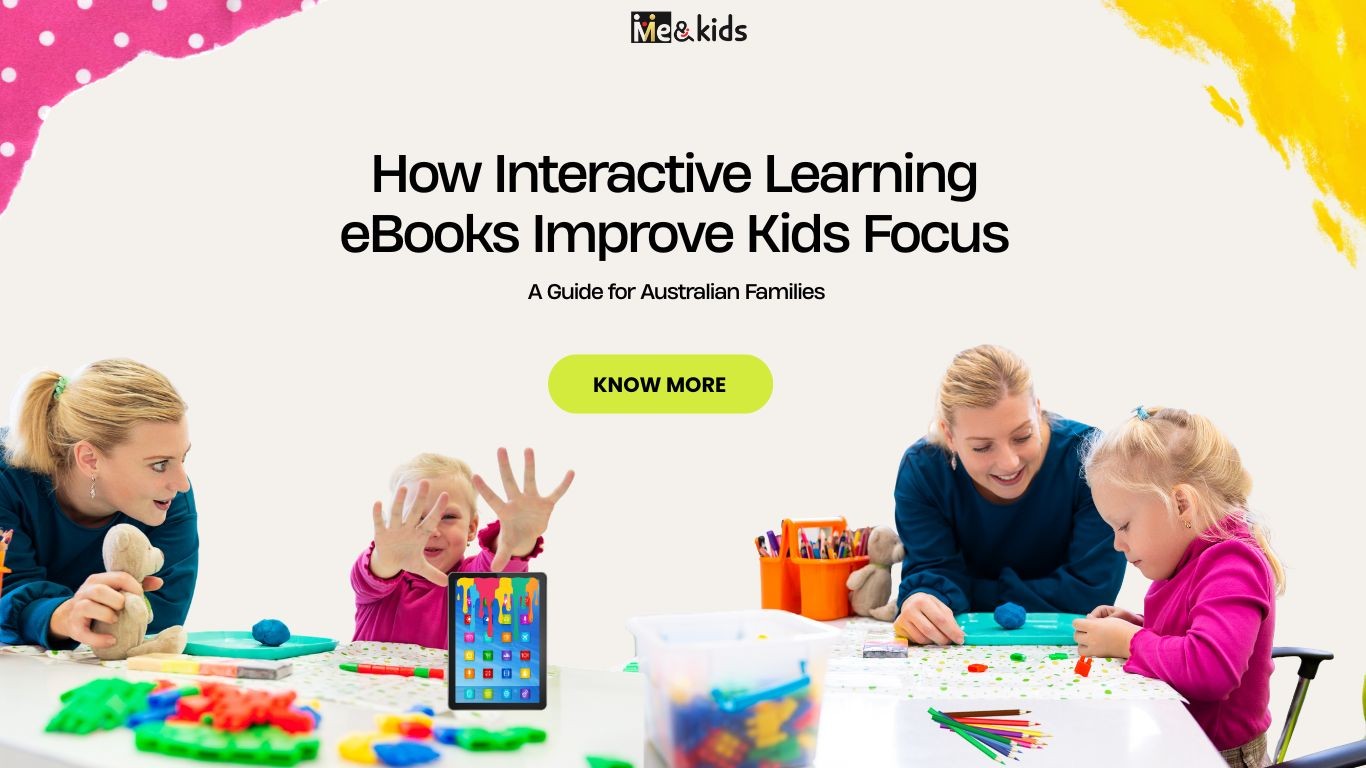
This guide explains how interactive learning eBooks improve focus, concentration, and cognitive development in children across different age groups, drawing on the full Me and Kids eBook collection. It covers the neuroscience of children's attention, why digital learning tools designed for engagement outperform passive screen time, and how specific categories of educational content, from bedtime story reading and drawing activities through to brain puzzles, English worksheets, and emotional intelligence resources, build the foundational skills that determine a child's capacity for sustained, purposeful attention. The guide features the complete Me and Kids children's learning eBook collection and explains how each resource contributes to focus development in practical, age-appropriate terms.
Every parent who has watched their child skip across three different activities in the space of ten minutes, unable to settle, unable to finish, and increasingly frustrated by their own inability to stick with something, has wondered the same thing. Is this normal? Is this a problem? And what, if anything, can I do about it?
The answer to the first question is yes, children's attention systems develop over time, and the capacity for sustained focus is not innate but trained. The answer to the second question is nuanced, because the digital environment that most Australian children now inhabit has changed the conditions under which that training either happens or fails to happen. And the answer to the third question is the focus of this entire guide.
Focus, or sustained voluntary attention, is not simply the ability to sit still. It is the brain's capacity to direct cognitive resources toward a chosen task, maintain that direction in the face of distraction, and sustain effort across a meaningful period of time. It is the skill that underlies reading comprehension, mathematical reasoning, creative problem-solving, and social-emotional intelligence. A child who cannot focus cannot learn efficiently, regardless of how intelligent they are. Building that capacity early, through the right kinds of daily engagement, is one of the most valuable investments an Australian parent can make in their child's development.
The Me and Kids platform was built with this understanding at its core. Every resource in the children's eBook collection, from educational bedtime stories to brain puzzle books and English comprehension worksheets, has been selected or created to engage children's attention in a way that builds rather than depletes their capacity for focused learning.
The neuroscience of children's attention has become one of the most urgently studied fields in developmental psychology, and its findings are increasingly relevant to every Australian parent navigating decisions about screens, devices, and the kinds of digital content their children engage with.
The prefrontal cortex, the region of the brain most responsible for sustained attention, impulse control, and executive function, develops slowly. It does not reach full maturity until the mid-twenties. During childhood and early adolescence, it is highly responsive to the quality of the cognitive inputs it receives. Environments that demand sustained engagement with progressively challenging material strengthen the neural pathways associated with focused attention. Environments dominated by rapidly switching stimuli, short-form video, social media feeds, and algorithmically optimised content designed to hold attention through novelty rather than depth, work in the opposite direction.
This distinction is critical for understanding why interactive learning eBooks occupy a different category from most children's digital content. A learning eBook requires a child to maintain attention on a single piece of content long enough for it to yield understanding. A brain training games resource requires the child to hold a problem in working memory, apply rules, and generate an answer. A reading comprehension exercise requires the child to process meaning, retain context, and respond to questions that demand genuine cognitive effort. Each of these activities, repeated across weeks and months, builds the attentional capacity that passive consumption erodes.
Australian children spend an average of more than four hours per day on screens according to multiple recent surveys, and the vast majority of that time is devoted to content that rewards shallow, rapid engagement rather than deep, sustained focus. Replacing even thirty minutes of that daily screen time with structured engagement with a quality learning eBook can produce measurable improvements in attention, reading fluency, and academic performance over a single school term.
Not all digital content is created equal, and the distinction between interactive learning eBooks and passive digital entertainment is not merely philosophical. It is neurological, educational, and measurable.
Passive screen content, whether television, short-form video, or social media, engages the brain's reward circuitry through novelty and visual stimulation. It requires little from the child cognitively because the content does the work. Attention is held by external stimulation rather than generated internally through engagement with a meaningful challenge. This kind of attention is sometimes called exogenous attention, pulled by the environment rather than directed by the child.
Interactive learning eBooks engage a fundamentally different attentional system. When a child follows a narrative, solves a puzzle, completes a drawing activity, or works through an English worksheet, they are exercising what researchers call endogenous attention, the self-directed kind that originates from within the child's own cognitive engagement with the task. This is the type of attention that improves with practice, that transfers across contexts, and that predicts academic achievement across every subject area.
The structured nature of quality learning eBooks also introduces an element that passive content entirely lacks: completion. A child who reads a bedtime story to the end, finishes a page of brain puzzles, or completes a drawing activity has experienced the cognitive and emotional satisfaction of task completion. That experience, repeated regularly, builds the behavioural pattern of following through that underlies every form of disciplined learning.
The bedtime story is one of the oldest and most well-validated learning rituals in human culture. Modern neuroscience has simply confirmed what parents have known intuitively for generations: a story read aloud at bedtime builds vocabulary, strengthens listening attention, develops empathy, and creates the calm, settled transition into sleep that supports next-day cognitive performance.
The Me and Kids bedtime story collection offers twenty-five original Australian children's stories, each designed to be read in a single sitting, each built around a theme of natural wonder, science, or environmental discovery, and each crafted to engage a child's attention through narrative momentum while delivering genuine educational content through the story itself.
Oliver and the River Monster is a bed times story about a curious boy, a swelling river, and the surprising science of floods. It is exactly the kind of bedtime stories for kids that holds a child's attention through genuine suspense and resolves into understanding rather than anxiety, the ideal combination for focus building at the end of a day.
Isla and the Deep Sea Secret introduces children to the layered world of ocean science through the experience of diving deeper than light can reach. Noah and the Sky That Exploded transforms a thunderstorm into a physics lesson. Ruby and the Fire Mountain takes a girl to the edge of a volcano and explains geological forces through the language of adventure. Archie and the Ice Age Giant sends a young explorer back to prehistoric Australia. These are not generic children's stories. They are designed to be genuine personalized story books experiences that feel specific, surprising, and intellectually alive.
Mia and the Coral Kingdom, Evie and the Dinosaur Footprint, Leo and the Shaking Ground, Max and the Rocket Countdown, and Scarlett and the Speedy Shark continue the science-adventure arc across marine biology, palaeontology, earth science, space exploration, and ocean ecology. Each story is structured to hold a child's attention through a rising narrative arc, a moment of discovery, and a satisfying resolution that leaves the child informed, curious, and calm.
Harper and the Melting Mountain, Toby and the Wind That Worked, Zara and the Star Patterns, Henry and the Giant of the Sea, Addison and the Plastic Rescue, Hudson and the Sun Catchers, Isla and the Lighthouse Storm, Amelia and the Ice Walkers, Benjamin and the Recycling Truck, Harrison and the Red Planet, Brodie and the Bridge Builders, Sienna and the Secret Ocean River, Caleb and the Firewise Forest, Isla and the Busy Bees, and Georgia and the Fast Train complete the collection, covering glacial science, renewable energy, astronomy, whale migration, ocean conservation, solar power, coastal history, polar ecosystems, recycling, space, engineering, ocean currents, bushfire ecology, pollination, and transport physics.
These are short bedtime stories in format but substantial in content. For Australian parents who want great bedtime stories that do real educational work while settling a child for sleep, this collection is the most practical and complete free resource available anywhere in Australia.
Reading one story per night, in a consistent routine, builds the listening attention, narrative comprehension, and vocabulary that are the direct precursors of independent reading fluency. Children who are read to nightly for a sustained period enter formal reading instruction with an enormous cognitive advantage over peers who were not, and that advantage compounds across every subject area throughout primary school.
Sustained visual attention and fine motor engagement are two of the most direct routes to building a child's capacity for focused work, and drawing activities sit at the intersection of both. When a child engages with a directed drawing exercise, they must attend carefully to what they are doing, maintain visual concentration on the detail of their work, coordinate hand movement with what they see, and persist through a task that requires patience and incremental progress.
The Me and Kids Drawing Activity eBook collection offers a range of drawing and creative activities designed for different age groups and levels of fine motor development. For parents looking for fun and easy drawings that introduce young children to directed creative work, the collection includes accessible starting points that build confidence alongside the skill of sustained visual attention.
Activities covering drawing for 3 year olds use simple shapes and familiar subjects to develop the hand-eye coordination and directional attention that form the foundation of later writing and reading readiness. Activities for older children introduce more complex compositions, including drawing ocean animals, seasonal and festive subjects, and emotionally expressive drawing that connects creative activity with the development of emotional literacy.
The focus benefit of drawing activities is not intuitive to every parent, but it is well-supported by research. Studies in educational psychology consistently find that children who engage in regular structured drawing activities show improved concentration across all learning tasks, not just creative ones. The mechanism is clear: drawing demands sustained, voluntary attention to detail, and that demand, practiced regularly, strengthens the neural systems responsible for focused attention across the board.
Fun drawings to draw that are accessible and rewarding build a positive association with the experience of sustained effort, which is one of the most important attitudinal foundations of academic success. A child who has learned that sticking with a drawing until it is finished produces something they are proud of has learned something about persistence that generalises far beyond the art table.
Mathematical thinking and focused attention develop together in ways that most parents do not fully appreciate until they watch a child struggle with both simultaneously. The capacity to count accurately, to hold a number in working memory while performing an operation, and to track a sequence through multiple steps requires exactly the kind of sustained, purposeful attention that learning eBooks are designed to build.
The Me and Kids Counting Numbers eBook provides structured, age-appropriate numeracy activities for early learners that build the foundational mathematical literacy children need before formal schooling begins. Activities covering counting numbers through visual and tactile approaches develop number sense, sequence awareness, and the pattern recognition that underpins later arithmetic.
For younger children, drawing for 3 year olds activities that combine counting with visual representation make abstract numerical concepts concrete and accessible. The combination of counting and drawing in a single activity engages multiple cognitive systems simultaneously, which research in early childhood education associates with stronger memory consolidation and deeper conceptual understanding than either activity in isolation.
Fun drawings to draw that incorporate number recognition, such as counting fish, drawing sets of objects, or colouring quantities, bridge the gap between creative engagement and mathematical thinking in a way that feels natural and enjoyable to young children while delivering genuine learning outcomes.
Structured counting activities also introduce children to one of the most important cognitive habits in all of learning: checking your work. A child who counts a set of objects and then recounts to verify the result is practising self-monitoring, which is a core component of metacognitive awareness, and one of the strongest predictors of academic achievement across every discipline. Building this habit in the context of enjoyable, accessible counting activities sets a template that children carry into every subsequent learning context.
If there is a single category of learning activity most directly associated with building focused attention in children, it is structured problem-solving games. Puzzles, brain teasers, logic challenges, word games, and pattern recognition exercises all demand the same cognitive posture: hold the problem in mind, apply available information, generate and test solutions, and maintain engagement until the answer emerges. This is focused attention in its most direct and trainable form.
The Me and Kids Brain Games eBook is the most cognitively demanding resource in the children's learning collection and one of the most valuable. It covers an extensive range of puzzle games and cognitive challenges suitable for children at different stages of development, from accessible memory games and word-finding activities through to more demanding logic puzzles and mathematical challenges.
Activities including sudoku puzzles at age-appropriate difficulty levels train number logic and systematic thinking. Crossword puzzles build vocabulary, spelling, and the ability to retrieve information from memory under moderate cognitive pressure. Word search puzzles develop visual scanning attention and letter pattern recognition. Brain teasers and mind games develop flexible, lateral thinking.
Research in cognitive neuroscience is consistent on one point: the brain responds to the challenges placed on it by building the structures and pathways needed to meet those challenges more efficiently over time. This is the principle of neuroplasticity applied to educational practice. Brain training games that are appropriately challenging, neither so easy that they require no effort nor so difficult that they produce frustration, sit in what developmental psychologists call the zone of proximal development, and it is in this zone that cognitive growth is fastest and most durable.
For Australian parents who want a resource that directly and demonstrably improves their child's capacity for focused problem-solving, the Brain Games eBook is the most direct investment available in the Me and Kids collection. Used for twenty to thirty minutes per day, this resource builds the kind of disciplined, structured thinking that serves children across mathematics, reading, science, and every other academic domain they will encounter throughout their education.
Reading and focused attention have a bidirectional relationship: strong reading comprehension requires focused attention, and practising reading comprehension builds focused attention. This is one of the most powerful feedback loops in all of education, and it is why structured reading and English activities are among the most effective tools available for improving a child's overall cognitive capacity.
The Me and Kids English Worksheets eBook provides structured literacy activities for Australian children across a range of year levels, from early primary through to middle school. The collection includes year 3 english worksheets, year 4 english worksheets, year 5 english worksheets, year 6 english worksheets, year 7 english worksheets, and year 8 english worksheets, making it one of the most broadly applicable single resources in the collection.
Activities including reading and comprehension worksheets require children to read a passage carefully, hold meaning in working memory, and respond to questions that test literal comprehension, inferential reasoning, and vocabulary understanding. These are exactly the cognitive operations that develop sustained, purposeful attention because they cannot be completed through shallow, passive engagement. A child who glosses over a comprehension passage and attempts to answer questions from partial information quickly discovers that the activity demands genuine reading rather than approximation.
Regular engagement with structured English activities also builds the reading habit itself, and the reading habit is one of the strongest predictors of academic success across every subject area. Children who read for at least thirty minutes per day outside school consistently outperform their peers in reading, writing, mathematics, science, and social understanding. The cognitive skills developed through reading, sustained attention, vocabulary acquisition, inferential reasoning, and pattern recognition, are not subject-specific. They are general cognitive tools that improve performance across the entire curriculum.
Sustained attention is not purely a cognitive skill. It has a significant emotional component that most discussions of children's focus and learning either ignore or address superficially. A child who is anxious, emotionally dysregulated, or chronically stressed cannot focus effectively regardless of how intelligent they are or how well-resourced their learning environment is. The emotional and attentional systems are deeply interconnected, and supporting one without addressing the other produces limited and fragile results.
The Me and Kids Beyond IQ eBook addresses this foundational dimension of children's learning directly. This resource covers the principles of emotional intelligence, including self-awareness, emotional regulation, and personal growth, in terms that are accessible and practical for Australian families. It helps children and parents understand how emotional states affect cognitive performance, and provides frameworks for developing the inner stability that makes sustained learning possible.
Research in developmental psychology and neuroscience consistently finds that children with strong emotional intelligence, particularly the capacity for self-regulation and emotional awareness, demonstrate superior attention control, better working memory performance, and significantly higher academic achievement than children with equivalent cognitive ability but weaker emotional regulation. The relationship between emotional intelligence and academic focus is not correlational. It is causal. Addressing the emotional dimension of learning is not a soft supplement to academic preparation. It is a prerequisite for it.
For Australian parents who want to support their child's learning capacity at its foundation, the Beyond IQ eBook provides an evidence-informed framework that is both practically useful and intellectually honest about the complexity of what makes children effective learners.
The capacity for focused digital learning is one of the most important skills Australian children will need across their entire educational and professional lives. This is not a controversial observation. It is a straightforward reflection of the direction in which both education and work are moving. Children who develop the habit of engaging with structured, purposeful digital learning resources in their early years are building the foundation for success in a learning environment that is increasingly online, increasingly self-directed, and increasingly dependent on the capacity for sustained independent engagement.
The Me and Kids Online Education Explained eBook provides Australian families with a clear, practical guide to the landscape of online education, including how digital learning works, what distinguishes effective online learning from ineffective screen time, and how families can build productive digital learning habits that will serve children across school, higher education, and beyond.
The Learning Online eBook extends this foundation into practical strategies for flexible, self-directed learning in digital environments. For Australian children who will spend a significant proportion of their educational careers engaging with content through screens, developing the habits of focused digital engagement, of treating a screen as a tool for purposeful learning rather than a portal for passive entertainment, is a skill with enormous long-term value.
Together, these two resources give Australian families the conceptual framework and practical tools they need to make digital learning work in their household, not as a replacement for physical activity, social interaction, or offline reading, but as a structured, intentional supplement that builds capability and confidence in the digital learning environments their children will inhabit throughout their lives.
Building children's focus through learning eBooks works most effectively when it sits within a broader daily routine that supports the biological conditions for sustained attention. Two of the most important and frequently overlooked contributors to children's cognitive performance are nutrition and physical movement.
The brain consumes approximately twenty percent of the body's total energy, and the quality of the fuel it receives directly affects its capacity for sustained attention. Australian children who begin the day without breakfast, or who consume high-sugar, highly processed foods, show measurably worse performance on attention tasks than children who start the day with nutritionally dense, whole-food meals. The Me and Kids platform includes the Healthy Diet and Weight Loss for Kids eBook as a free resource that covers evidence-based nutritional guidance for Australian families, with specific attention to the eating patterns that support children's cognitive performance and concentration throughout the school day.
Physical movement is equally important. Research from the University of Western Australia and multiple international institutions consistently finds that children who engage in regular vigorous physical activity show significantly better sustained attention, faster cognitive processing, and stronger working memory than sedentary peers. The Australian National Physical Activity Guidelines recommend that children aged five to seventeen engage in at least sixty minutes of moderate to vigorous physical activity every day. Building movement breaks into a daily learning eBook routine, rather than treating movement and learning as competing activities, produces better learning outcomes than extended sedentary study sessions of equivalent total duration.
The research on children's focus and learning is consistent on one point above all others: consistency matters more than intensity. A child who engages with a quality learning eBook for twenty minutes every day will develop stronger attentional capacity, better literacy skills, and more durable learning habits than a child who does two-hour learning sessions on weekends and nothing during the week. The brain responds to regular, repeated practice, and it is the regularity more than the duration that drives development.
A practical daily learning eBook routine for Australian families might look something like this. In the morning, before school or alongside breakfast, a short engagement with the counting numbers resource or a page of English worksheets builds cognitive readiness for the day ahead. After school, when children need a transition activity that is calmer than screen entertainment but more engaging than rest, a session with the brain games eBook or a drawing activity provides structured stimulation that bridges the afternoon-to-evening energy shift. At bedtime, one of the twenty-five original Me and Kids bedtime stories provides the narrative engagement, vocabulary exposure, and emotional settling that support both sleep quality and next-day learning performance.
This three-point daily routine, morning, afternoon, and bedtime, uses no more than forty-five minutes of the day, costs nothing, requires no specialist equipment, and builds the foundational cognitive skills that determine how effectively a child learns across every other context in their day.
The Me and Kids platform makes this routine genuinely effortless. Every resource in the children's learning collection is free, accessible on any device, and structured to be used independently by children who are ready for self-directed learning or together with a parent for children who need more scaffolding. The platform is updated regularly, ensuring that families always have access to new content that maintains the novelty and variety that sustain long-term engagement.
Do learning eBooks actually improve children's attention spans?
Yes, when they are well-designed and used consistently. Research in educational psychology finds that structured, interactive digital learning activities that require sustained cognitive engagement, such as comprehension exercises, puzzle games, and directed drawing, build the neural pathways associated with voluntary attention in ways that passive screen content does not. The key variables are engagement quality and consistency of use. A child who engages with a learning eBook for twenty focused minutes per day across a school term will show measurable improvements in sustained attention compared to a child who does not.
At what age should Australian children start using learning eBooks?
Children benefit from structured reading and learning activities from a very early age. The bedtime story eBooks in the Me and Kids collection are appropriate from age three onward, with some stories better suited to younger children and others to older primary-age readers. The drawing and counting activities are designed from age three upward. The brain games and English worksheets are most suited to children aged six and above, with the year-level worksheet collection covering children from year three through to year eight.
How long should a child spend with a learning eBook each day?
For most children, twenty to thirty minutes of focused engagement with a quality learning resource delivers the cognitive and attitudinal benefits associated with improved attention and academic performance. Multiple shorter sessions across the day, such as the morning, afternoon, and bedtime structure described above, are more effective than a single extended session. The goal is to build the habit of regular, purposeful engagement rather than to accumulate the largest possible total learning minutes in any given day.
Can learning eBooks replace school learning?
No, and they are not designed to. Learning eBooks are a supplement to formal education, not a substitute for it. Their value lies in building the foundational skills, vocabulary, attention, numeracy, emotional regulation, and problem-solving capacity, that allow children to engage more effectively with formal schooling. The most significant effects are seen when families use eBook learning resources consistently alongside regular school attendance and active parental engagement with their child's learning.
Are the Me and Kids learning eBooks aligned with the Australian Curriculum?
The Me and Kids children's learning resources are designed with the developmental stages and content areas of the Australian Curriculum in mind, particularly in literacy, numeracy, and the sciences. The bedtime story collection is particularly well aligned with the Australian Curriculum's emphasis on environmental science, earth science, and STEM themes. The English worksheets are structured around the year-level expectations of the Australian Curriculum for English. The platform is updated regularly to ensure that new resources reflect current curriculum priorities.
Where can I access all of the Me and Kids children's learning eBooks in one place?
The complete collection of children's learning eBooks, including bedtime stories, drawing activities, counting resources, brain games, and English worksheets, is available through the printable activities and children's learning section of the Me and Kids platform. Every resource is free to access, and the platform is updated regularly with new content. The broader Me and Kids eBook and course library, covering parenting, health, fitness, wellbeing, and family learning across every age group, is available at meandkids.com.au.
Read Next -
Published by Me and Kids – Australia's trusted resource for family learning, children's development, parenting, and wellbeing. All children's learning eBooks, bedtime stories, printable activities, and family resources mentioned in this guide are free to access at meandkids.com.au.